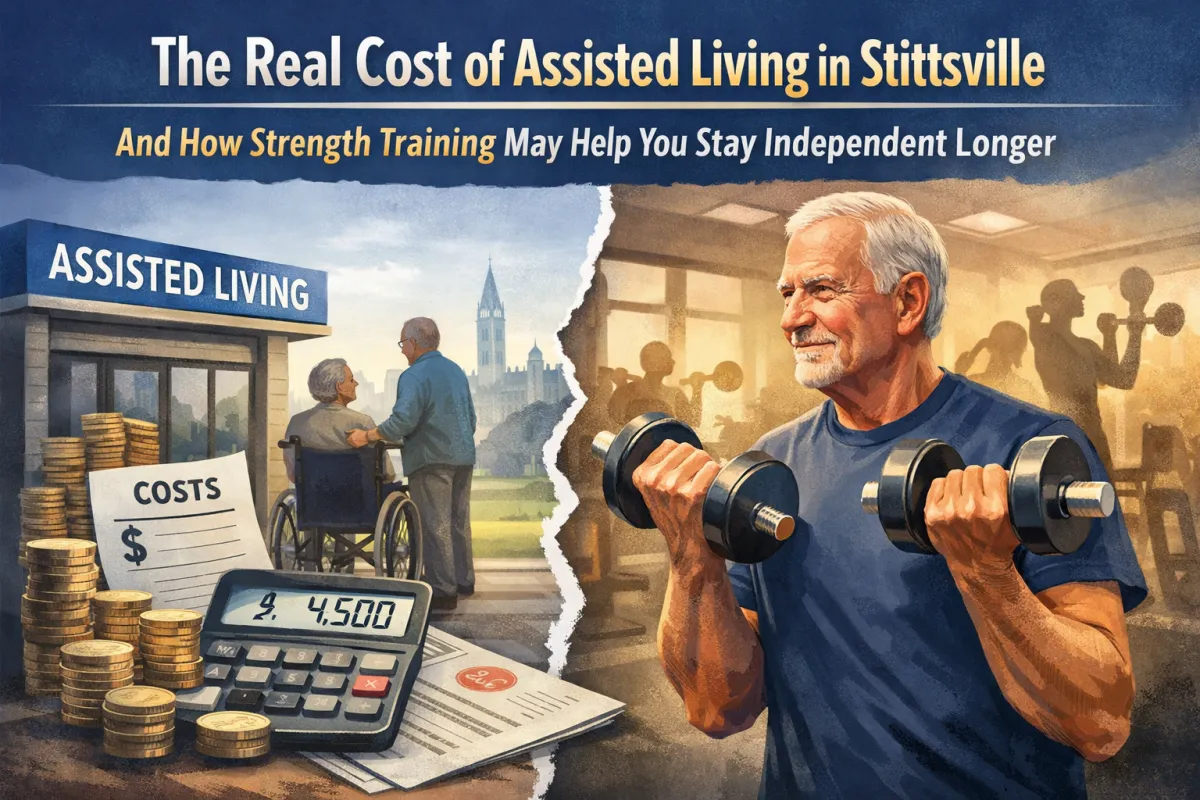
The Real Cost of Assisted Living in Stittsville — And How Strength Training May Help You Stay Independent Longer
If you’ve recently searched:
“Cost of assisted living in Stittsville”
“Retirement home costs Ottawa”
“Senior living Ontario pricing”
“How much does assisted living cost per month?”
You’ve likely discovered something sobering.
Assisted living in the Ottawa region is not inexpensive — and for many families, the numbers add up faster than expected.
But there’s a second question most people don’t ask:
What determines whether someone needs assisted living in the first place?
Because in many cases, it isn’t age.
It’s strength.
What Does Assisted Living Actually Cost in Ottawa / Stittsville?
There isn’t one flat number. Costs vary depending on the residence, level of care, and added services.
Base Monthly Cost (Room & Board)
In the Stittsville region, retirement residences and assisted living typically start around:
$3,500 – $6,500 per month
That usually includes:
Private or semi-private suite
2–3 meals per day
Utilities
Basic housekeeping
Social programming
General supervision
But that’s just the base.
Additional Services That Increase Monthly Costs
Most residents require additional support as needs change.
Common add-ons include:
Medication Management
$300 – $800 per month
Assistance With Daily Living
(Bathing, dressing, mobility help)
$500 – $2,000+ per month
Memory Care Support
Often adds $1,000 – $3,000 per month
Enhanced Nursing Care
$500 – $1,500 per month
Specialized Diets or Extra Services
$200 – $500 per month
Realistic Total Monthly Range
For someone requiring moderate support:
$4,500 – $7,500 per month
For higher levels of care or memory support:
$7,000 – $10,000+ per month
Annually, that becomes:
$54,000 per year (lower end)
$75,000 – $90,000 per year (moderate care)
$100,000 – $120,000+ per year (higher care levels)
And costs typically rise over time.
This isn’t meant to alarm.
It’s meant to inform.
Because once you understand the numbers, you can think strategically.
Most People Don’t Move to Assisted Living Because They Turn 80
They move because:
They fall.
They lose lower-body strength.
Stairs become unsafe.
Getting up from a chair becomes difficult.
Chronic pain limits independence.
Balance declines.
The biggest predictor of losing independence isn’t age alone.
It’s loss of muscle mass and functional strength.
After age 50, adults naturally lose 1–2% of muscle per year — unless they intentionally train to preserve it.
That loss compounds.
But here’s the empowering part:
Muscle is trainable at any age.
The Concept of “Healthspan”
Lifespan is how long you live.
Healthspan is how long you live independently.
You cannot stop time.
But you can influence strength, balance, and mobility.
And those are directly tied to whether someone can safely remain in their home.
While no exercise program can guarantee avoiding assisted living, maintaining strength and balance is one of the strongest predictors of functional independence in later decades.
What If Strength Training Delays Assisted Living by 2–10 Years?
Let’s use conservative math.
If assisted living averages:
$60,000 per year (low–moderate care)
$80,000 per year (mid-range)
$100,000+ per year (higher care)
Then delaying the need for assisted living by:
2 Years
$120,000 – $200,000 preserved
3 Years
$180,000 – $300,000 preserved
5 Years
$300,000 – $500,000+ preserved
10 Years
$600,000 – $1,000,000+ preserved
This isn’t about fear.
It’s about planning.
Even a short delay meaningfully changes long-term financial outcomes.
What Does Prevention Cost?
At Between The Bumpers, structured personal training twice per week costs:
$90 per session
2 sessions/week = $180/week
≈ $720 per month
≈ $8,640 per year
Over five years:
≈ $43,200 invested in strength, balance, and mobility.
Compare that to one year of assisted living at $75,000–$90,000.
The numbers speak for themselves.
But more importantly — so does independence.
Starting Earlier Creates a Greater Buffer
Based on aging research trends:
Beginning structured strength training at 55–60 may delay functional decline 5–10 years.
Starting at 60–70 may delay decline 3–8 years.
Starting at 70+ still improves balance and strength, potentially delaying decline 1–5 years.
The earlier someone builds strength, the more protection they build into later decades.
This isn’t about lifting heavy weights recklessly.
It’s about:
Leg strength
Core stability
Balance
Grip strength
Joint integrity
Safe, progressive programming
It’s structured.
It’s supervised.
And it’s designed specifically for real life.
For Adult Children Researching Assisted Living for a Parent
If you’re researching assisted living in Ottawa for a parent, consider this:
Sometimes the most cost-effective intervention isn’t a facility.
It’s structured strength training.
Helping a parent maintain mobility and balance may:
Reduce fall risk
Preserve independence longer
Delay transitions to higher-care environments
Improve quality of life immediately
You’re not just buying workouts.
You’re buying time.
Aging in Place in Stittsville Starts With Strength
Many families say they want to “age in place.”
But aging in place isn’t a wish.
It’s a physical capacity.
You need:
The strength to stand up independently.
The balance to navigate stairs.
The endurance to carry groceries.
The stability to prevent falls.
Those qualities don’t stay by accident.
They stay by design.
Future you will thank you for starting earlier rather than later.
Curious What the Math Looks Like for You?
We’ve created a simple Assisted Living Delay Calculator that compares:
Assisted living costs at different care levels
Personal training investment
Estimated years of delay
Potential financial difference
It’s not medical or financial advice.
It’s perspective.
If you’re 55–75 and want to protect your independence — or if you’re supporting a parent who does — the best time to build strength is now.
👉 Book a No-Sweat Intro and let’s build a plan that supports real life.
Because this isn’t about avoiding aging.
It’s about staying strong enough to live on your terms.
And that’s an investment worth making.